Auto Backup Files to FTP, Cloud & NAS
Pick a folder, pick a destination, pick a schedule. FTPie copies your files to an FTP server, a cloud account or a NAS on its own, and tells you how each run went.
Simple Three-Step Setup
Select files/folders from any storage and choose where to backup
Set schedule, retention, compression, and encryption options
Name your backup and save - it will run automatically
Flexible Scheduling Options
Run at specific time each day
Choose specific days and time each week
Set backup frequency in hours, days, or weeks
Run backups only when you choose
Health at a glance
A backup you never look at is only useful if you can trust it - and the honest way to earn that trust is to make its state obvious. The backup list reads like a monitoring dashboard rather than a list of settings:
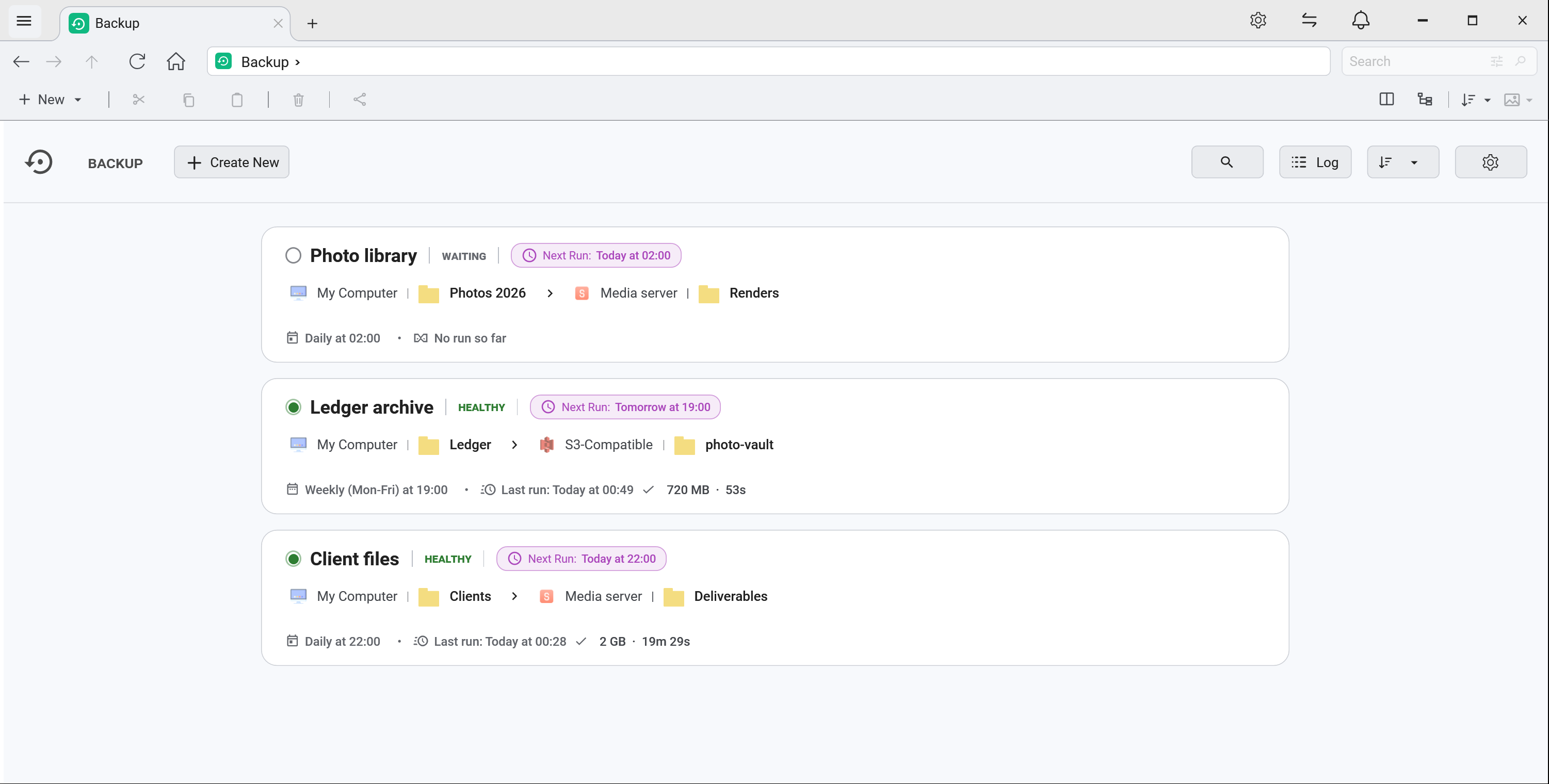
- A status dot next to every backup - green when the last run succeeded, amber when something went wrong recently, red when the last run failed, grey when it is paused, and an empty ring when it has never run
- A run-history bar on hover - one mark per recent run, next to "Last run", so "solid all week" and "fails every other night" look different at a glance
- Hover a mark for that run - when it ran, how it ended, how much it moved, how long it took, and the error if there was one
- Click a mark to open the activity log narrowed to that exact run

The dot reflects the last finished run and deliberately doesn't change while a backup is running - the "In progress" badge already says that. A run interrupted because the app closed or the machine restarted counts as amber, not red: it isn't a fault in the backup.
Advanced Backup Management
- Real-time Status - View next run time, health, and last run status for each backup
- Backup History - See detailed history with duration, transferred size, and status for each run
- Activity log - Every backup, scheduled transfer and folder notification in one place, newest first, with filters for the job, the severity and the time range. It is saved to disk, so closing FTPie no longer loses the record of what ran overnight
- Pause/Resume - Temporarily pause any backup without losing configuration
Retention no longer erases history, either. Cleaning up old snapshots used to delete the record that those runs ever happened - and because it only cleaned up successful ones, what you were left with looked far worse than reality. Old snapshots are still reclaimed exactly as before; the record of the run stays.
- Compression Level: Choose from multiple compression levels for optimal speed vs size
- Encryption Options: Plain password, 128-bit AES, or 256-bit AES encryption
- Smart Transfer: Files are downloaded locally for compression (unless source is local)

Backup Policies & Management
Choose what happens if backup is missed: Skip, Run Immediately, or Wait for Next Schedule
Auto-cleanup by days or number of backup versions
Easy Backup Management
All your backups are displayed in a clean vertical list with search functionality. Each backup item shows:
- Backup name and description, with its health dot
- Source files/folders and destination location
- Next scheduled run time
- Last run status and timestamp, plus the run-history bar on hover
- Pause/resume toggle
Restore any backup snapshot straight back to its original location or to a new one - no manual transfer needed. It works for both plain and compressed (password-protected zip) snapshots, across local, FTP/SFTP, NAS and cloud, including cloud-to-cloud and cross-account restores.
Safe-replace keeps your live data intact: FTPie stages the restore and only swaps in verified files, so if a run is interrupted your originals are never destroyed.
Notifications - know how every run went
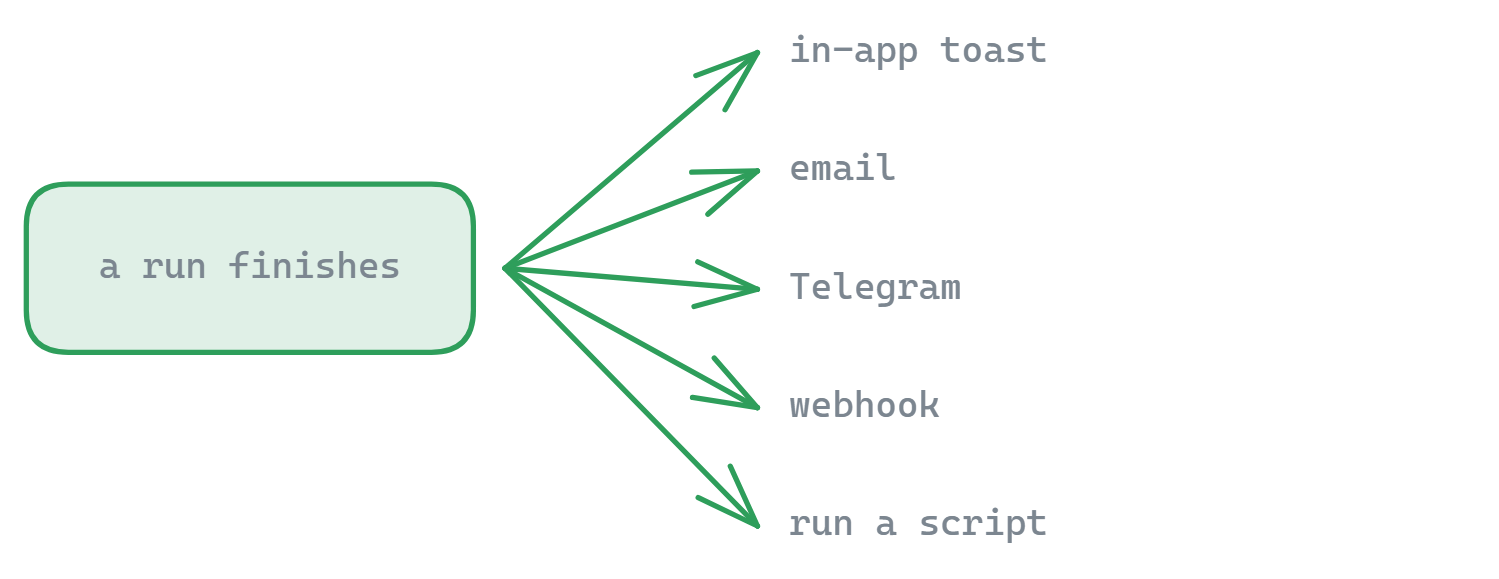
You no longer have to open FTPie to check on a backup. Each backup can notify you when a run finishes, through any combination of channels:
- In-app toast - a popup in FTPie summarizing the result and where the data went
- Email - sent through your own Gmail, Outlook or custom SMTP account
- Telegram - a message to your chat via a bot
- Webhook - an HTTP call you can wire into your own systems
- Run a local app or script - launch an executable with the run context passed automatically
Triggers are configurable per event - on failure, completed with errors, or on success - with sensible defaults (failures on, successes off) that each backup can override. There are also options to automatically clean up data from interrupted backups and to warn about missed scheduled backups when you close FTPie.
In the app itself, only genuine failures raise a notification. Successful runs are recorded quietly on the activity log, where you can go and read them when you want to - rather than interrupting you to say nothing was wrong.
Usage Scenarios
Auto Backup is perfect for protecting important documents, project files, photos, and any data you can't afford to lose. Use it to automatically sync work files to cloud storage, backup photos from your camera to FTP server, or create encrypted backups of sensitive documents to multiple locations. For a step-by-step walkthrough, see the guide on how to automate PC to cloud backups.
Automatically backup family photos, important documents, and personal projects to cloud storage with encryption
Protect work files with scheduled encrypted backups to multiple locations with detailed audit logs
Auto Backup lives inside a file manager - ideal when backups are one of many transfer jobs. If backup is the whole job, we also build BackupKit, Windows backup software dedicated to exactly that: encrypted, versioned file backups to the same clouds, NAS devices, and servers, with a health dashboard per job.
What it does not do
Auto Backup runs on your PC, so a scheduled job only fires while FTPie is running - it is not a server-side agent and it will not back anything up while the machine is off. It also keeps file copies rather than disk images, so it is not a bare-metal restore tool. For backups that must run unattended around the clock, use a dedicated always-on solution.
Common questions
Any storage you have connected - an FTP, FTPS or SFTP server, a cloud account such as Google Drive, OneDrive or Dropbox, a WebDAV endpoint, a NAS share, or object storage like S3. The source can be a local folder or another remote storage.
Yes. FTPie is a desktop app, not a server agent - a scheduled job runs when the app is running on your machine. If you need backups that continue while the PC is off, that is a job for a server-side or always-on solution.
Yes. A job can zip its contents before upload, and can encrypt them with AES-256 so the files land on the destination unreadable without your password. Both are set per job.
Every run is recorded with its result, and the backup view shows the state of each job at a glance. You can also have FTPie notify you when a run finishes or fails.
Auto Backup is part of FTPie Pro. The free plan covers up to 3 FTP/FTPS/SFTP connections; Pro adds cloud, WebDAV, NAS and self-hosted storage plus backups, with a 30-day free trial. See the plan comparison.
Related
- Scheduled transfers - the same scheduling engine, for one-way transfer jobs
- File encryption - AES-256 before anything leaves your machine
- Automated encrypted cloud backups - the full walkthrough
- Back up to a NAS - Synology, QNAP and any SMB share
Start Your 30-Day Free Trial
Download FTPie and start your free 30-day trial. Enjoy seamless FTP + cloud integration and keep using the free version afterward.
Download Free Trial